Certifications for Stainless Steel Drinkware Manufacturers: FDA, LFGB, and California Proposition 65 Compliance
When sourcing stainless steel drinkware, ensuring that your manufacturer holds the right certifications is critical for legal compliance and product safety. For buyers targeting the U.S. and European markets, FDA, LFGB, and California Proposition 65 are three key standards. This guide explains what to look for and how to evaluate suppliers, using a real-world example from NGOPT.
Why Certifications Matter in Supplier Screening
Certifications are not just paperwork—they demonstrate a manufacturer's commitment to quality, safety, and regulatory compliance. A stainless steel drinkware manufacturer without proper certifications exposes you to recalls, customs seizures, and reputational damage. During supplier screening, always verify factory qualifications, production capacity, and testing standards.
1. FDA Compliance for the U.S. Market
The U.S. Food and Drug Administration (FDA) regulates food contact materials. Stainless steel drinkware must meet FDA requirements for food-grade materials, ensuring they are safe for beverages and do not leach harmful substances. A compliant manufacturer should have FDA certification or test reports for their products.
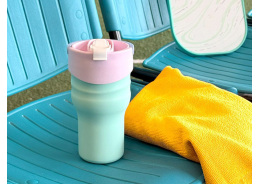
In the product description for the Modern 304 Stainless Steel Vacuum Thermos Cup, the manufacturer states that many products have passed FDA certification in the United States. This is a strong indicator of compliance.
2. LFGB Compliance for the European Market
LFGB (Lebensmittel-, Bedarfsgegenstände- und Futtermittelgesetzbuch) is the German Food, Consumer Goods, and Feed Code. It is widely recognized across Europe as a stringent standard for food contact materials. LFGB certification ensures that the drinkware is safe and does not release harmful chemicals.
The same manufacturer of the NGOPT thermos cup also holds LFGB certification in Europe, according to the product information. This makes them suitable for European buyers.
3. California Proposition 65
California Proposition 65 (Prop 65) requires businesses to provide warnings for significant exposures to chemicals known to cause cancer, birth defects, or other reproductive harm. For stainless steel drinkware, this often relates to lead, cadmium, and other heavy metals in materials or coatings.
Unlike FDA and LFGB, Prop 65 is not a certification you earn; it is a compliance requirement. Manufacturers should provide test reports showing that their products do not exceed safe harbor levels for listed chemicals. While the product information for the NGOPT Modern 304 Stainless Steel Vacuum Thermos Cup does not explicitly mention Prop 65, buyers should always request Prop 65 test reports or a compliance declaration before importing to California.
4. Other Certifications to Consider
Beyond the three main standards, reputable stainless steel drinkware manufacturers often hold additional certifications:
- ISO 9001 – Quality management system certification.
- CE – European conformity mark for certain products.
- DGCCFR – French certification for food contact materials.
- BSCI – Factory inspection for social compliance and ethical sourcing.
The manufacturer of the NGOPT thermos cup has completed ISO9001 quality management certification, CE certificate, DGCCFR certification and testing in France, and BSCI factory inspection. These credentials demonstrate a well-rounded commitment to quality and compliance.
5. Evaluating Factory Qualifications and Production Capacity
Certifications alone are not enough. You must also assess the factory's ability to produce consistently and at scale. Key factors include factory floor area, employee count, technical teams, and daily output.
According to the product information, the manufacturer (Wuyi Huakun Daily Metal Products Co., Ltd.) is located in Yongkang, Zhejiang Province, the hardware capital of China. Its factory floor area was 20,000 square meters by 2021, with more than 500 employees, 18 technical teams, and 50 sales teams. The company completed automatic production in 2021 and can reach a daily output of 50,000 finished cups. This capacity makes them suitable for large orders.
They work with common materials including 304 stainless steel, 201 stainless steel, and 316 stainless steel. Logos can be customized, and structures can be single or double layer. For sampling, the current sample is issued in 1-2 days, and proofing generally takes 7 days, depending on requirements.
6. Sample and Testing Protocols
Before committing to a bulk order, always request samples and third-party test reports. Testing standards vary by market. For Europe and the U.S., the manufacturer states that FDA, LFGB, CE, and ISO9001 are the requirements of most customers. Ensure that the test reports are current and cover the specific materials and colors you plan to order.
For the NGOPT thermos cup, available colors include Deep Blue and Beige. You can request a sample to verify insulation performance (12-24 hours thermal insulation) and build quality.
Conclusion: Your Supplier Screening Checklist
To ensure compliance and quality, verify that your stainless steel drinkware manufacturer has:
- FDA certification for the U.S. market.
- LFGB certification for the European market.
- California Proposition 65 test reports or declarations.
- Additional certifications such as ISO9001, CE, DGCCFR, and BSCI.
- Proven production capacity and a well-equipped factory.
- Clear sampling and testing protocols.
By using these criteria, you can confidently select a manufacturer like the one behind NGOPT's Modern 304 Stainless Steel Vacuum Thermos Cup, which already holds FDA and LFGB certifications and meets a wide range of international standards.
 English
 German
 French
 Russian
 Spanish
 Japanese
 Korean
 Portuguese
 Ukrainian
 Arabic
 Italian


